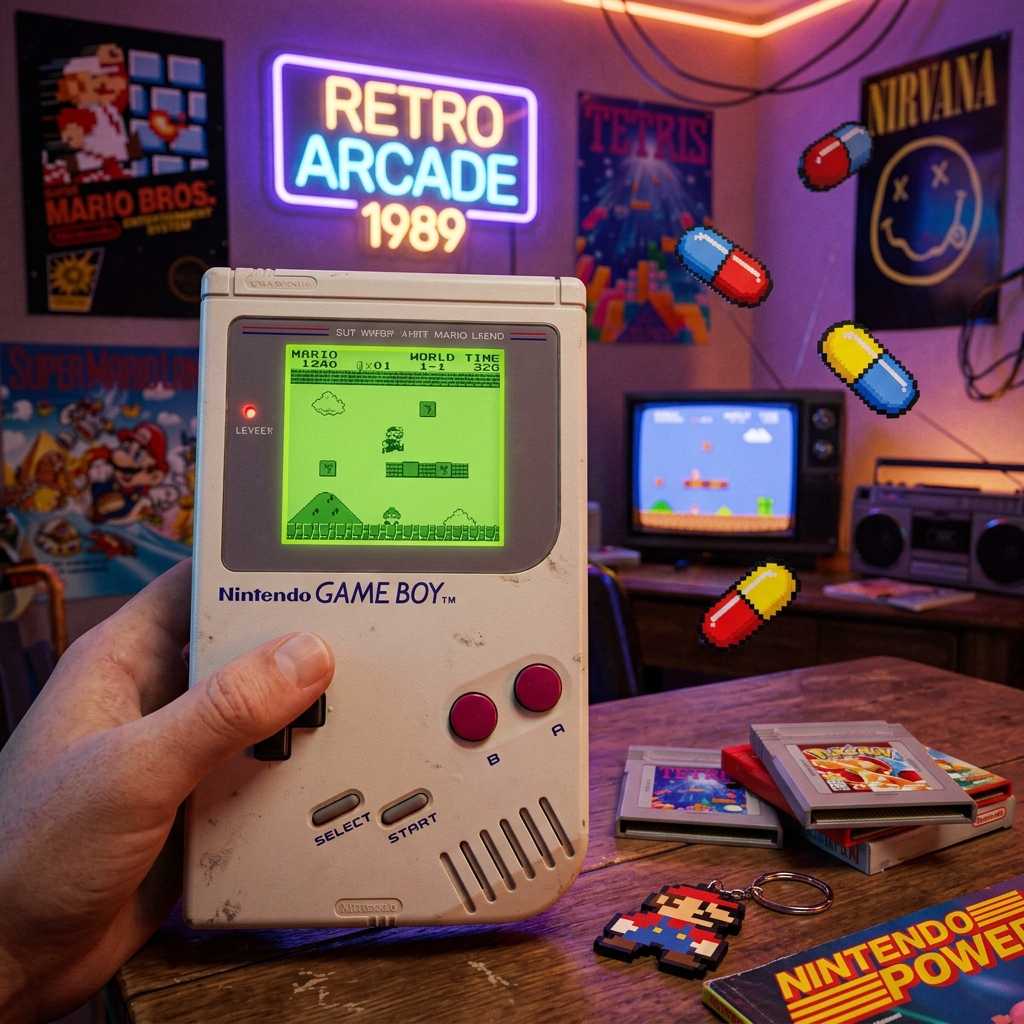
When Nintendo released the Game Boy in 1989, it permanently altered the landscape of electronic entertainment. At the absolute forefront of this portable revolution stood two landmark releases: Super Mario Land and the legendary puzzle spin-off Dr. Mario. For players exploring mario games, these titles provided high-quality platforming and cognitive puzzles on-the-go. Together with SNES visual compilations like *Super Mario All Stars* and early creative platforms like *Mario Paint*, this era defined how versatile the plumber could be across multiple genres.
Historically, *Super Mario Land* was unique because it was the first major Mario game developed without Shigeru Miyamoto's direct oversight. Instead, the Game Boy's hardware creator, Gunpei Yokoi, spearheaded the project. This led to a beautifully bizarre, unique iteration of the franchise set in **Sarasaland**, featuring Sphinxes, alien spaceships, and bouncing Superballs instead of fireballs. Let us dive deep into the mechanics, level strategies, and legacy of these handheld triumphs.
1. Super Mario Land Sarasaland Walkthrough
Set in a brand new kingdom consisting of four distinct geographical regions (Birabuto, Muzak, Easton, and Chai kingdoms), super mario land features highly compressed, fast-paced 8-bit gameplay that is remarkably easy to learn but difficult to master:
- The Superball Flower: Replacing the Fire Flower due to Game Boy screen limitations, the Superball Flower lets Mario shoot a single bouncy sphere. Unlike standard fireballs, the Superball bounces off solid walls at perfect 90-degree angles and can be used to collect distant coins in narrow crevices.
- Unique Vehicle Levels (Worlds 2-3 & 4-3): Unlike any home console entry, Super Mario Land features shooting stages. In World 2-3, Mario pilots the *Marine Pop* submarine, firing torpedoes at seahorses. In World 4-3, Mario takes to the skies in the *Sky Pop* airplane to shoot down flying chickens and battle the alien overlord **Tatanga**.
- Finding the Beanstalk exit: Every platforming stage ends with a two-tiered exit door. The upper door triggers an immediate bonus roulette minigame yielding valuable lives (up to 3 Lives) and Cape Feather-equivalent items, but reaching it requires executing pixel-perfect jumps off high falling platforms.
2. Dr. Mario Puzzle Masterclass: Pill Placement Strategies
Shortly after the platformer's success, Nintendo released Dr. Mario (and its subsequent *doctor mario* variants), creating a massive competitive puzzle wave. Designed as a falling-block matching game, it tasked players with eliminating colorful viruses inside a medicine bottle using bi-colored megavitamins:
The rules of dr mario are deceptively simple: drop vitamins next to viruses of matching colors (Red: Fever, Yellow: Weird, Blue: Chill). Aligning four blocks of the same color in a horizontal or vertical row instantly eliminates them. However, high-level play requires advanced strategic foresight to prevent cluttering the bottle:
- Color Matching Priorities: Always focus on eliminating the highest-placed viruses first. A common rookie mistake is clearing lower viruses, leaving floating capsule fragments that block access to the top of the bottle.
- Drop and Slide: Just like in Tetris, you can slide capsules underneath overhanging blocks during the fraction of a second before the pill locks into place. Master the double-rotate slide technique to secure difficult color slots.
- Combos & Cascades: When a row clears, any unsupported capsule halves will fall down. Advanced players deliberately build cascades, dropping hanging halves into secondary viruses to trigger chain reactions and score massive points.
3. Creative & Consolidated Classics: Mario Paint & All Stars
Following the handheld revolution, the SNES consolidated this creative peak. In 1992, Nintendo released **Mario Paint**, a creative suite bundling a custom SNES mouse and mousepad. Players could paint, compose MIDI tracks using classic Mario sounds, and play the addictive fly-swatting minigame *Gnat Attack*. This expanded the franchise beyond simple high-scores and into user-generated content, paving the way for modern titles like *Super Mario Maker*.
Simultaneously, **Super Mario All Stars** (*super mario all stars*) compiled high-fidelity 16-bit remakes of Super Mario Bros 1, 2, 3, and The Lost Levels onto a single SNES cartridge. Featuring fully redrawn assets and synthesized scores, it stands as one of the earliest and most successful compilation remasters in gaming history, showing players the true artistic progression from 8-bit to 16-bit.
4. Emulation & Portable Games Online
Today, classic handheld titles like Super Mario Land and competitive puzzle masterworks like Dr. Mario are fully unblocked for browser-based play. Modern JS and WASM Game Boy emulators let you play mario games online in full-screen on both desktop and mobile layouts with no downloads. Experience Sarasaland and eliminate clinical viruses with zero-latency touch controls and responsive gamepads right in your browser!
Recommended Resources & Reading
Mastering retro platforms? Level up your skillset with our other helpful developer and gameplay walkthroughs:
- Super Mario Bros (NES): The Ultimate 1985 Level Walkthrough & History Retrospective
- Super Mario Bros 3 Secrets: Deep Suit Power-Ups & Warp Whistles Secrets
- Super Mario World Guide: Complete Dinosaur Land Walkthrough & Yoshi Shells Guide
- Super Mario 64 Unblocked: N64 Browser Emulation, Keys & Star Secrets
For more detailed historical context and community speedruns, check out these excellent external resources:
- Read the detailed history on the official Wikipedia Super Mario Land Page.
- Read the comprehensive strategy guide on StrategyWiki.
- Explore Game Boy technical details on the Super Mario Wiki.