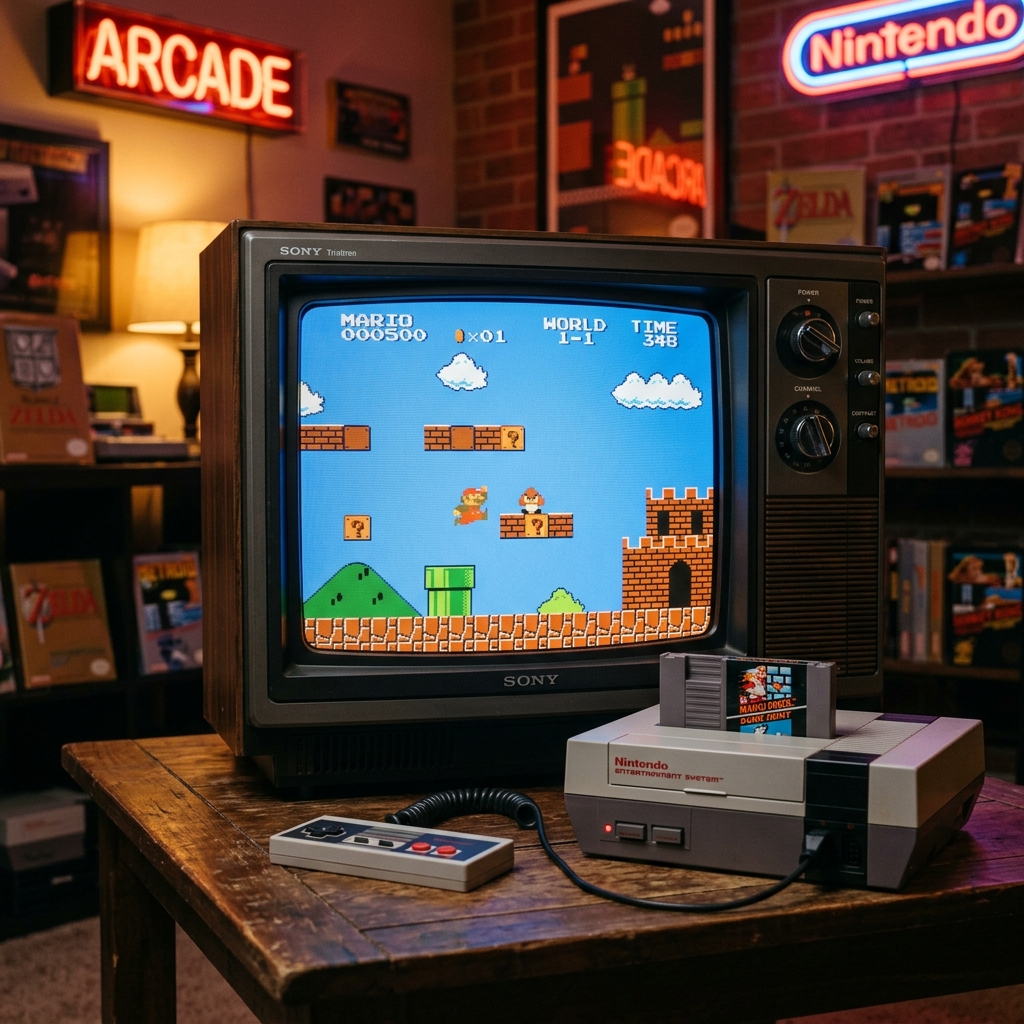
Released in September 1985 for the Nintendo Entertainment System (NES), Super Mario Bros stands as one of the most significant video games of all time. Engineered by legendary designers Shigeru Miyamoto and Takashi Tezuka, it saved the American gaming industry following the 1983 crash, sold over 40 million copies, and established a masterclass in platform game design that developers still study today. The legacy of this super mario bros game spans generations, creating a global phenomenon that transformed Nintendo from a playing card company into an international entertainment titan.
To fully appreciate the genius of supermario bros, one must examine the state of gaming in 1985. Arcades were dominated by single-screen high-score chasers like Pac-Man and Donkey Kong. The idea of a sprawling, scrolling journey through a fantasy landscape—with physics-based movement, continuous musical scores, and hidden secrets—was completely revolutionary. Let's delve deep into the mechanical, design, and historical aspects of this industry-defining masterpiece.
1. The Genius of World 1-1: Teaching Without Tutorials
One of the most famous aspects of the original super mario brothers is its introductory level, World 1-1. Unlike modern games that clutter the viewport with intrusive instructional pop-ups or lengthy unskippable cutscenes, World 1-1 is an absolute masterclass in **organic, intuitive tutorial design**. Every brick, enemy, and item is meticulously placed to teach the player the rules of the Mushroom Kingdom without a single word of text:
- First Enemy (Goomba): Placed immediately to the right, moving slowly towards the player. Because the human eye reads left-to-right, the player instantly understands that their primary direction is to the right. The approaching threat of the Goomba forces the player to react, leading them to discover the A button (jump).
- The Question Blocks & Pit: Just above the Goomba float several gold flashing blocks. If the player jumps to avoid the Goomba, they will likely bump into one of these blocks, revealing a coin or a Super Mushroom. The Super Mushroom slides right, hits a green pipe, and bounces back toward Mario. Because a high pipe blocks their path forward, the player is forced to jump, ensuring they collide with the Mushroom. They instantly grow double in size, showing them that mushrooms are positive power-ups.
- High Gaps and Safe Hazards: As the level progresses, the pipes get progressively higher, teaching the player that holding down the jump button increases their jump height (variable jump height mechanics). Shortly after, a wide open pit appears, but it is accompanied by a solid platform above it. If the player falls, they lose a life; if they use the platform, they cross safely, cementing the risk-and-reward nature of platforming.
2. Core Physics, Inertia, and Fluid Controls
The fluid physics and controls are why players still enjoy playing mario brothers today. Miyamoto and his team spent months refining Mario's movement before even drafting the levels. They wanted to ensure that controlling the plumber felt satisfying in its own right, like an extension of the player's reflexes. The game utilizes a precise combination of acceleration, inertia, and momentum:
When you press Left or Right on the D-Pad, Mario does not immediately reach maximum velocity. Instead, he accelerates along a curve. Similarly, when you release the D-Pad, Mario does not halt instantly; he skids to a stop, carrying his inertia. Holding down the Run button (Shift on keyboards, B on NES controllers) lets Mario sprint, building up horizontal momentum. This momentum is critical: it allows Mario to jump across wide, bottomless pits that are otherwise impossible to cross, and alters his jump trajectory.
Furthermore, the game features robust air control. Unlike older arcade titles like *Ghosts 'n Goblins* where a jump direction was completely locked once initiated, super mario bros. allows players to make micro-adjustments to Mario's trajectory in mid-air. This high skill ceiling allows professional speedrunners to execute pixel-perfect maneuvers, dodging hazards with fractions of a millimeter to spare.
3. The Mushroom Kingdom Arsenal: Power-Ups Catalog
The game introduced classic power-ups that have become cultural symbols worldwide. These items do not just grant visual changes; they completely alter how the player interacts with the levels:
- Super Mushroom: Transforms small Mario into Super Mario. This allows the player to absorb one hit from enemies without dying (reverting to small Mario instead of losing a life) and grants the ability to smash brown brick blocks from below to discover hidden coins or secret pathways.
- Fire Flower: Mapped to the Run/Fire button, it grants Super Mario the ability to shoot bouncing fireballs. Fireballs are highly effective for defeating tough enemies—like Piranha Plants, Hammer Bros, and even Bowser—from a safe distance. In underwater stages, fireballs can even defeat swimming Bloopers and Cheep Cheeps.
- Super Star (Starman): Grants temporary, flashing invincibility. Mario runs faster, jumps slightly wider, and instantly defeats any enemy by simply touching them. However, it does not protect against falling into bottomless pits or running out of time on the level clock!
- 1-Up Mushroom: A rare, green-spotted mushroom hidden inside invisible blocks. Collecting it awards the player an extra life. Learning the exact coordinates of these hidden blocks is essential for completing the game without using continues.
4. Secret Warp Zones: Fast Tracking Your Speedruns
For players trying to outrank friends or run fast speedruns, Miyamoto hid secret "Warp Zones" that allow skipping entire worlds, creating an early form of non-linear gameplay that rewarded exploration:
- World 1-2 Warp Zone: At the end of the underground stage, ride the rising elevator platforms to the very top, and run across the ceiling blocks above the exit pipe. Continue running to the right to find three Warp Pipes leading to Worlds 2, 3, and 4.
- World 4-2 Warp Zone: In the underground region of 4-2, climb the hidden beanstalk inside a block near the middle of the level. This leads to a cloud sub-level where you can run across the ceiling to find pipes leading to Worlds 6, 7, and 8.
5. Glitches & Easter Eggs: The Minus World
Due to the limited cartridge space of the NES, the game contains several famous glitches that have become legendary. The most famous is the **Minus World** (World -1). By standing on the exit pipe of World 1-2, crouching, and jumping backward through the solid brick wall, the player can clip into the Warp Zone room before the game loads the "Warp Zone" text. Entering the far-left pipe sends Mario to World -1, an endless, repeating loop of an underwater stage that cannot be beaten in the NES version, serving as a fascinating digital trap for retro gamers.
Another classic trick is the **Infinite Lives Shell Bounce** in World 3-1. At the very end of the level, two Koopa Troopas walk down the stone stairs. By landing on the second Koopa at the precise angle as it descends the step, Mario can continuously bounce on its shell without touching the ground, racking up millions of points and spawning infinite 1-Up lives.
6. Outranking the Competition: Play Super Mario Bros Online
Decades after its 1985 debut, the physics, level designs, and musical score composed by Koji Kondo remain flawless benchmarks of game design. Whether you are a casual player looking to relive childhood memories or a speedrunner optimizing pixel-perfect movement, playing super mario bros online has never been easier. Modern HTML5 emulation allows you to play mario online in full-screen directly in your browser, featuring instant save states, zero-latency inputs, and fully responsive controls on both desktop and mobile viewports.
Recommended Resources & Reading
Mastering retro platforms? Level up your skillset with our other helpful developer and gameplay walkthroughs:
- Super Mario Bros 3 Secrets: Deep Suit Power-Ups & Warp Whistles Secrets
- Super Mario World Guide: Complete Dinosaur Land Walkthrough & Yoshi Shells Guide
- Super Mario 64 Unblocked: N64 Browser Emulation, Keys & Star Secrets
- Super Mario Land & Dr. Mario: Game Boy Portable Guides & Puzzle Strategies
For more detailed historical context and community speedruns, check out these excellent external resources:
- Read the detailed history on the official Wikipedia Super Mario Bros Page.
- Explore comprehensive stage maps and secrets on Super Mario Wiki.
- Learn about Nintendo's console design history on the official Nintendo Corporate Site.