
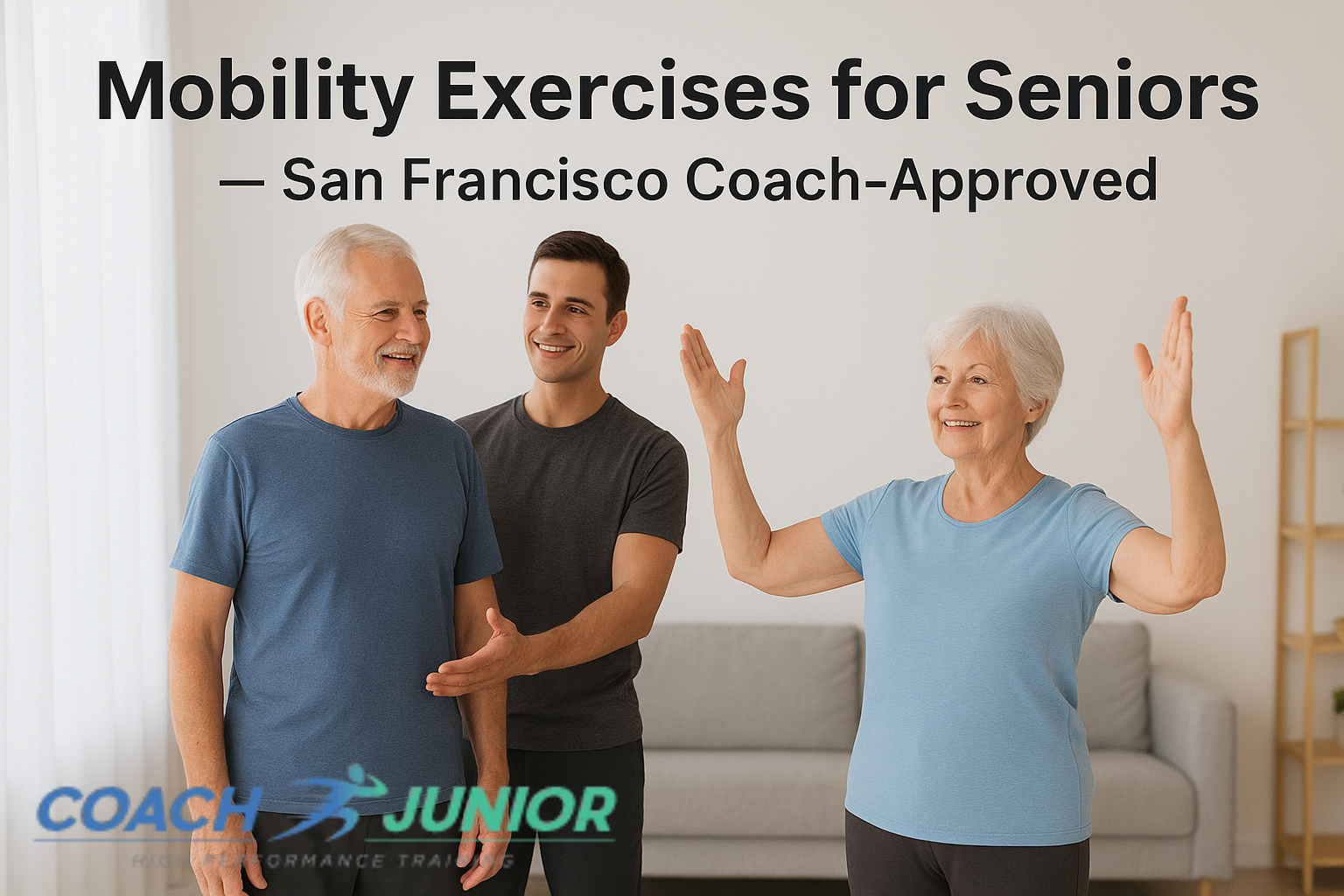
Mobility matters. Not because it sounds impressive, but because it’s the quiet thing that keeps you independent: getting out of a chair, stepping onto a curb, turning to reach for a cup. This practical guide shows mobility exercises for seniors you can do at home, on a park bench, or with an in-home coach. Designed for older adults in San Francisco (and everywhere else), these routines emphasize safety, real-world function, and consistency — not flashy moves.
Whether you’re looking for chair exercises for seniors, fall prevention work, or a daily mobility habit, this guide delivers step-by-step cues, progressions, and modifications. Coach Junior offers in-home sessions and park coaching across San Francisco, so if you’d like one-to-one help putting these senior mobility exercises into practice, we can come to your home or meet you at Golden Gate Park or the Embarcadero.
Why mobility matters as we age
As we get older, joints stiffen, reaction speed slows, and small losses of range-of-motion add up fast. Mobility is not just about touching your toes — it’s about controlled movement that lets you perform everyday tasks with ease. Good mobility reduces the risk of falls, pain, and frustration. It also means spending less time recovering and more time doing the things you love — walking in San Francisco’s hills, tending a garden, or playing with grandkids.
The difference between mobility, flexibility, and strength
- Mobility = the ability to move a joint actively through a range with control.
- Flexibility for senior = the passive length of a muscle (how far you can be stretched).
- Strength = how much force your muscles can generate.
You need all three. But mobility is the bridge: it lets your strength work through the right range. These mobility exercises for seniors focus on controlled, usable movement — not passive stretching alone.
Everyday wins: why a little movement pays off
Do ten minutes of consistent mobility work and you’ll notice small but meaningful changes: standing from a low chair becomes easier, balance improves, and you’ll feel more confident on uneven sidewalks in San Francisco neighborhoods like Noe Valley or the Richmond. Small wins compound — and that’s what keeps independence intact.
Quick safety checklist before you start
Before you begin any routine, run a quick safety check:
- Can you breathe normally during movement?
- Do you have a stable chair and a nearby wall or counter for support?
- Are you wearing shoes with grip (outdoors) or socks with traction (indoors)?
- Do you have clearance from your doctor if you’ve had recent surgery, uncontrolled heart issues, or severe dizziness?
When to check with a doctor or PT
Consult a physician or physical therapist if you have: recent fractures, joint replacements within the last 6–12 weeks (follow surgeon guidance), unstable heart conditions, sudden unexplained pain, or new neurological symptoms. If in doubt, be cautious and ask.
Tools and supports: chair, wall, band, park bench
You don’t need a gym. Essentials:
- A sturdy chair (no wheels)
- A wall or counter for balance support
- A light resistance band or towel (optional)
- A park bench for outdoor practice in san francisco
Coach Junior uses simple props in sessions to make mobility training accessible and transferable to real life.

10-minute Chair Routine — perfect for beginners
This short seated routine is ideal for people starting mobility work, recovering from injury, or preferring low-impact movement. It’s designed to be repeated daily.
How to use this routine (sets, reps, cues)
- Do each exercise for the prescribed reps or time.
- Move slowly and with control — think “smooth and steady.”
- Breathe: exhale on effort, inhale on release.
- If any movement causes sharp pain, stop and modify.
- Aim for 10 minutes daily; progress by adding repetitions or moving to standing versions.
Exercise 1 — Seated March (H4)
How to: Sit tall at the front of the chair. Lift the right knee up toward the chest, lower, then left. Keep shoulders relaxed.
Reps/time: 1–2 minutes or 20 marches total.
Why: Improves hip flexor control and prepares you for walking.
Coach tip: Imagine marching to the beat of a slow drum — controlled and rhythmic.
Exercise 2 — Seated Heel-Toe Rocks (H4)
How to: Sit with feet flat. Rock the heels up (lifting toes), then rock toes up (lifting heels) so weight shifts from forefoot to heel.
Reps/time: 20–30 alternating reps.
Why: Increases ankle mobility and ankle-sensor awareness (important for balance).
Modification: Extend time if ankles feel stiff — the goal is fluid movement.
Exercise 3 — Seated Knee Extension (Leg Lift) (H4)
How to: Sit tall. Extend one leg forward until it’s straight (knee soft), hold 2 seconds, lower. Alternate.
Reps/time: 10–15 per leg.
Why: Activates quads, improves knee control for standing and stairs.
Coach tip: Keep your core engaged — don’t hinge in the lower back.
Exercise 4 — Seated Torso Twist (H4)
How to: Sit with feet grounded, hands across chest. Rotate slowly to the right, return, then left.
Reps/time: 8–10 each side.
Why: Restores thoracic mobility for reaching and turning safely.
Modification: Reduce range if you have spine discomfort; focus on rotation from the middle-back, not the lower back.
Exercise 5 — Seated Ankle Circles (H4)
How to: Lift one foot slightly, rotate the ankle clockwise 10 times, then counterclockwise.
Reps/time: 10 circles each direction per ankle.
Why: Keeps ankles supple and improves proprioception (knowing where your feet are).
Standing Mobility exercises for senior — balance & confidence
When seated work feels comfortable, carefully progress to standing versions. These challenge balance and build usable strength.
How to progress safely
- Start with light support (hand on chair or wall).
- Perform fewer reps with control before increasing.
- If dizzy or unstable, return to seated regressions and reassess.
Exercise 6 — Sit-to-Stand (Controlled) (H4)
How to: From a seated position, lean forward slightly, push through heels, stand up slowly, then sit back with control.
Reps/time: 8–12 repetitions. 2 sets.
Why: Practical — it’s the movement you do dozens of times a day.
Progression: Reduce hand support, or perform from a lower seat to increase challenge.
Coach Junior note: We use sit-to-stands in SF homes to quickly evaluate strength and prescribe personalized progressions.
Exercise 7 — Standing Calf Raise (H4)
How to: Stand behind a chair, push up onto the balls of your feet, hold 1–2 seconds, lower.
Reps/time: 12–15 repetitions. 2 sets.
Why: Strengthens calves and improves ankle stability for hills and stairs — very relevant in San Francisco.
Modification: Perform single-leg holds with support when ready.
Exercise 8 — Side-to-Side Step & Reach (H4)
How to: Step to the side with right foot, reach arms toward the step, step back to center. Repeat left.
Reps/time: 10 each side.
Why: Challenges lateral movement control and coordination — prevents trips when stepping off a curb.

Hip, Back & Shoulder Mobility for senior
This section targets the joints most needed for everyday independence: hips for walking and stairs, spine for bending and twisting, shoulders for reaching.
Exercise 9 — Figure-Four Hip Stretch (modified) (H3)
How to: Sit at the front of a chair. Place the right ankle on the left knee (a gentle “4”). Sit tall and lean forward slightly to increase the stretch. Hold 20–30 seconds; switch sides.
Why: Releases outer hip and glutes; reduces stiffness when climbing steps.
Modification: If sitting is uncomfortable, do the figure-four lying on your back.
Coach tip: In a San Francisco session, we often pair this with functional transfers (e.g., stepping up a curb) to reinforce movement patterns.
Exercise 10 — Cat-Cow (seated or on hands/knees) (H3)
How to (on hands/knees): Arch your back toward the ceiling (cat), then drop your belly and lift your head (cow), moving slowly.
How to (seated): Sit tall, round your back and tuck chin (cat), then open chest and lift gaze (cow).
Reps/time: 8–12 rounds.
Why: Spinal mobility improves bending mechanics and reduces stiffness.
Exercise 11 — Wall Angels / Shoulder Rolls (H3)
How to (wall angels): Stand with your back near the wall, slide arms up and down like making a snow angel, keeping contact with the wall.
Reps/time: 8–10 reps.
Why: Restores shoulder range for reaching up and dressing — vital for independence.
Balance drills to reduce fall risk
Balance is trainable. Include short balance drills 3–5 times per week.
Tandem stance, heel-to-toe walk, single leg tap (H3)
- Tandem stance: Place one foot directly in front of the other and hold for 10–30 seconds (use support initially).
- Heel-to-toe walk: Walk in a straight line, placing heel of front foot to toe of back foot — 10–20 steps.
- Single leg tap: Lift one foot and lightly tap toe to the floor 5 times, hold single-leg balance for 5–10 seconds.
These drills improve proprioception and reduce falls—practice near a wall or chair for safety.
How to build a weekly mobility plan (sample 4-week plan)
Consistency and gradual progression are the keys. Here’s a simple 4-week plan to build a daily habit.
Week 1 to Week 4 — progressive plan (H3)
- Week 1 (Foundation): Daily 10-minute chair routine (Seated March, Heel-Toe Rocks, Knee Extensions, Torso Twists, Ankle Circles). Focus on form.
- Week 2 (Add balance): Continue chair routine 5 days/week. Add standing calf raises and 10 sit-to-stands (3x/week). Do 2 balance drills (tandem stance, heel-toe walk) 3x/week.
- Week 3 (Progress): Increase sit-to-stands to 12–15 reps. Add single-leg balance taps and side-to-side steps. Introduce mini lunges with support.
- Week 4 (Consolidate & Practice Real Tasks): Combine a 15-minute routine (warm-up, mobility, balance work). Practice functional tasks like step-ups on a curb with coaching guidance. Consider booking an in-home check to individualize the next cycle.
Coach Junior often runs this plan over four weekly coaching sessions in San Francisco, adjusting intensity to each client’s goals.
Why a coach helps — in-home and park coaching in San Francisco
Training alone works, but a coach accelerates progress, prevents compensations, and provides accountability.
Real benefits of 1:1 coaching vs. generic videos
- Personalized progressions for your history and limitations.
- Immediate feedback on form to avoid bad habits.
- Real-world practice — we replicate curb steps, stairs, and park benches.
- Motivation and consistency — it’s easier to keep going with a scheduled session.
What to expect from a Coach Junior session
A typical in-home or park session in San Francisco includes a brief assessment (sit-to-stand, single-leg hold), a tailored mobility circuit, and goal-based coaching (e.g., stair confidence). Sessions are practical, friendly, and designed to translate directly into everyday independence.

Common limitations & how to modify each move
Mobility exercises can be adapted to most conditions. Below are common scenarios and simple modifications.
For knee pain, hip replacements, low back issues (H3)
- Knee pain: Favor seated leg lifts over deep squats; avoid painful knee flexion. Use a higher chair for sit-to-stand.
- Hip replacement: Follow surgeon/physio restrictions (avoid extreme rotations initially). Use seated figure-four progressions and gentle hip flexor stretches.
- Low back issues: Prioritize pelvic neutral and thoracic mobility; use seated cat-cow and avoid deep forward bends. Perform movements in smaller ranges.
Coach Junior always applies “pain-free ranges” and modifies load and range to maintain safety.
Testimonials & local results (San Francisco neighborhoods)
“After four weeks with Coach Junior, I can get up from my living room chair without using my hands — and I walk the stairs to my Noe Valley apartment with confidence.” — Margo R., Noe Valley
“Coach Junior met me at the Marina and showed me how to practice curb steps safely. Such practical coaching for San Francisco life.” — Harold S., Marina District
(These are examples of the kinds of local results people see when they combine routine mobility work with targeted coaching.)
Conclusion
Mobility exercises for seniors are simple, practical, and high-impact. Ten minutes a day of carefully coached mobility work transforms stiffness into usable movement, boosts balance, and restores confidence — especially for life in San Francisco with its hills and curbs. If you want personalized support, Coach Junior offers in-home and park sessions across San Francisco to help you turn small moves into big independence.
If you’d like a printable PDF of the routine or to book a mobility check in San Francisco, reach out to Coach Junior via the website or schedule a trial session.
FAQs
How many times per week should seniors do mobility exercises?
Aim for daily short sessions (5–15 minutes). Balance and standing progressions 3–5 times per week. Consistency wins.
Can I do these exercises after a hip or knee replacement?
Often yes, but follow your surgeon’s timeline. Start with seated and gentle range-of-motion work; progress with a clinician or coach.
I live in San Francisco — are outdoor park sessions safe year-round?
Yes — San Francisco’s mild climate allows for year-round sessions. Choose flat, paved areas like promenades or benches, and avoid wet surfaces after rain.
What if I feel dizzy during balance drills?
Stop and sit. If dizziness continues or is new, consult your healthcare provider. Start with seated drills and progress slowly.
How can Coach Junior help me improve faster?
We provide tailored in-home or park sessions across San Francisco, real-world task practice (stairs, curbs), personalized progressions, and accountability to make mobility gains stick.
Edvandro Oliveira is a certified personal trainer, sports scientist, and the former Brazilian National Track & Field Coach. With over 15 years of experience, including coaching world-ranked Paralympic athletes, Edvandro (founder of Coach Junior) provides personalized, science-based training in running, bodybuilding, and conditioning to unlock clients’ full physical potential.